1.Basic definition of harmonic reducer gearbox
The harmonic reducer gearbox is a deceleration transmission device that drives the wave generator through the input end to make the flexspline produce elastic deformation and form a small tooth difference movement with the circular spline. It is essentially a mechanical speed change device that relies on the controllable elastic deformation of flexible components to realize the gradual meshing and disengagement of gears, so as to reduce the high-speed input speed and increase the output torque.
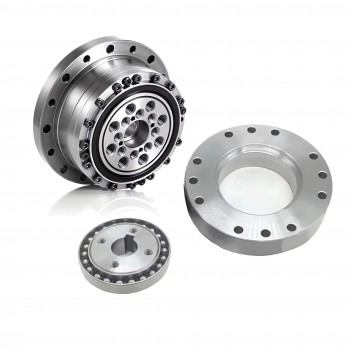
2.Main components of harmonic reducer gearbox
1.Circular Spline: It is a rigid annular part with an internal gear ring, which is usually fixed on the reducer body and provides stable support for the entire transmission system.Its number of teeth is slightly more than that of the flexspline, and the common tooth difference is 2 teeth, which is the key to realizing a large transmission ratio.
2.Flexspline: It is a flexible thin-walled elastic part with an external gear ring, usually installed at the output end of the reducer, and is the core component that realizes power transmission through elastic deformation.Its wall thickness is usually only 1-2 mm, which is made of special alloy steel through heat treatment and precision processing.
3.Wave Generator: It is the key component that generates controllable elastic deformation waves, usually composed of an elliptical cam and a thin-walled flexible bearing, and is installed at the input end of the reducer.When the wave generator is installed into the inner hole of the flexspline, it will squeeze the circular flexspline into a stable ellipse.
3.Importance of harmonic reducer gearbox
1.Guarantee the precision of equipment operation: The harmonic reducer gearbox has ultra-high precision and ultra-low backlash. Under the load condition of 1000N·m, the return error is only 0.5 arc minutes, which is 80% lower than that of the traditional planetary reducer, and can achieve 0.005mm level positioning precision. This precision is crucial for equipment that requires fine operation, such as industrial robots that complete precision parts assembly and chip welding, and Da Vinci surgical robots that perform minimally invasive operations.
2.Realize efficient power transmission: The harmonic reducer gearbox has a large single-stage transmission ratio, with a range of 30-320, which is more than 40% higher than that of the RV reducer. It can convert high-speed and low-torque input into low-speed and high-torque output, realizing the effect of deceleration and torque increase.
3.Promote the miniaturization and lightweight of equipment: Compared with the traditional reducer, the harmonic reducer gearbox does not need a complex planet carrier structure, and its volume and weight are only 1/3 of that of the traditional reducer, which has obvious advantages in power density. This is of great significance for equipment that has strict requirements on volume and weight, such as humanoid robots, aerospace equipment and medical instruments, which can help reduce the overall weight and volume of the equipment and improve its mobility and flexibility.
4.Ensure the stability and service life of equipment: The elastic meshing mode of the harmonic reducer gearbox can effectively buffer impact and vibration, and the operation noise is low. At the same time, the reasonable selection of materials and precision processing ensure its long service life. For example, after adopting nano-grease lubrication, the service life of the reducer can be extended from 8000 hours to 15000 hours, which can reduce the maintenance frequency and cost of the equipment and improve the stability and reliability of the equipment operation.
4.Manufacturing requirements of harmonic reducer gearbox
1.Material selection requirements: The material of each component must meet the national standard and performance requirements, and the purity and mechanical properties of the material must be strictly controlled.
2.Precision processing requirements: The harmonic reducer gearbox has extremely high requirements on processing precision, and the processing precision of key components needs to reach the micron level (0.001mm). For the gear teeth of the circular spline and flexspline, high-precision processing equipment such as five-axis CNC machine tools, grinding machines and hobbing machines should be used for processing, and customized tools should be matched to ensure the accuracy of tooth shape, tooth pitch and tooth surface roughness.
3.Heat treatment requirements: Heat treatment is a key link to improve the mechanical properties of components. Different components need to adopt corresponding heat treatment processes. For the flexspline, quenching and tempering treatment should be carried out to improve its strength and elasticity, and eliminate internal stress to avoid deformation during use.
4.Assembly requirements: The assembly process of the harmonic reducer gearbox requires high precision and strict operating standards. Before assembly, all components must be cleaned to remove oil, dust and other impurities to avoid affecting the meshing effect and service life of the reducer.
5.Testing and inspection requirements: After the manufacturing and assembly of the harmonic reducer gearbox, strict testing and inspection must be carried out to ensure that its performance meets the design requirements and national standards. The test items include no-load test, load test, transmission efficiency test, torsion stiffness test, transmission error test, backlash test and shell temperature test.
6.Mass production control requirements: In the mass production process, the consistency of materials, the stability and reproducibility of the production and assembly process, the completeness of detection and traceability, and cost control must be ensured.