Core Technologies of Switching Power Supply

1.Basic Definition of Switching Power Supply
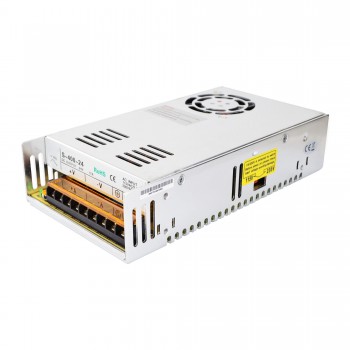
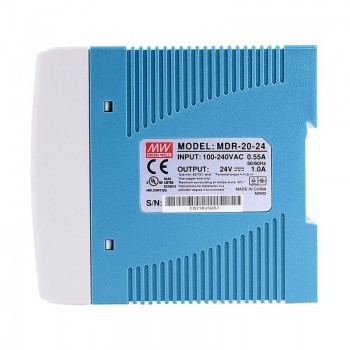
A switching power supply (also known as switching power converter) is a type of power supply device that uses power semiconductor devices (such as MOSFET, IGBT) as “switches”, which are turned on and off at high frequency (usually tens of kHz to hundreds of kHz) to control the transmission of electrical energy. Its core working principle is to adjust the duty cycle (the ratio of on-time to switching cycle) of the switching signal through the control circuit, so as to stabilize the output voltage or current.
2.Basic Working of Switching Power Supply
1.Input Rectification: AC voltage is converted to a high-voltage DC signal through a diode bridge and capacitor.
2.High-Frequency Switching: A power transistor (MOSFET) acts as a high-speed switch, turning the DC input into a high-frequency (20 kHz–500 kHz) pulse train.
3.Voltage Transformation: A small, high-frequency transformer or inductor steps the voltage down (or up) to the desired level efficiently.
4.Output Regulation: The switched signal is rectified back into DC and filtered using capacitors and inductors, with a feedback loop monitoring the output voltage to maintain stability.

3.Main Structural Components of Switching Power Supply
1.Input Circuit: It is composed of EMI filter, rectifier bridge and input filter capacitor. The EMI filter is used to suppress electromagnetic interference from the power grid and prevent the interference generated by the switching power supply itself from feeding back to the power grid; the rectifier bridge converts alternating current (AC) input into direct current (DC); the input filter capacitor filters the rectified DC to reduce voltage fluctuation.
2.Power Switching Device: It is the core executive component of the switching power supply, mainly including MOSFET and IGBT. It completes high-frequency on-off under the drive of the control signal, realizing the control of energy transmission.
3.High-Frequency Transformer: It undertakes the functions of isolation, voltage conversion and energy transmission. It isolates the input and output circuits to ensure the safety of the equipment; at the same time, it converts the input DC voltage into high-frequency AC voltage of the required amplitude, laying the foundation for the subsequent rectification and filtering.
4.Output Rectifier and Filter Circuit: It converts the high-frequency AC voltage output by the high-frequency transformer into smooth DC voltage through the rectifier diode and output filter capacitor, which meets the power supply requirements of the load.
5.Control and Drive Circuit: It is the “brain” of the switching power supply. It samples the output voltage or current, compares it with the reference value, and generates a PWM signal to drive the power switching device. By adjusting the duty cycle of the PWM signal, the output voltage or current is kept stable.
6.Protection Circuit: It is an important component to ensure the safe and reliable operation of the switching power supply, including over-voltage protection, over-current protection, over-temperature protection and short-circuit protection. When the power supply is in an abnormal working state, the protection circuit will quickly cut off the power supply or adjust the working state to avoid damage to the power supply and the load.
4.Core Technologies of Switching Power Supply
1.PWM (Pulse Width Modulation) Control Technology: It is the most basic and widely used control technology of switching power supply. By adjusting the on-time of the power switching device within each switching cycle, the average value of the output voltage or current is controlled, so as to achieve stable output.
2.High-Frequency Conversion Technology: The switching frequency is the key factor affecting the volume and power density of switching power supply. Increasing the switching frequency can reduce the volume and weight of high-frequency transformers and filter capacitors, realizing the miniaturization and high power density of the power supply.
3.Power Semiconductor Device Technology: The performance of power switching devices directly determines the efficiency and reliability of switching power supply. Traditional silicon-based devices have certain limitations in high frequency, high temperature and low loss.
4.Electromagnetic Compatibility (EMC) Technology: The high-frequency on-off of the switching power supply will generate strong electromagnetic interference, which will affect the normal operation of the power supply itself and other adjacent electronic equipment. EMC technology mainly includes EMI suppression and EMS enhancement.
5.Active Power Factor Correction (PFC) Technology: The input current of the traditional switching power supply is non-sinusoidal, which will generate harmonic pollution to the power grid and reduce the power factor. Active PFC technology uses the active circuit to adjust the input current, making it track the input voltage and present a sinusoidal waveform, which improves the power factor, reduces harmonic pollution, and makes the power supply more energy-saving and compliant with the power grid standards.
6.Multi-Mode Intelligent Control Technology: In practical application, the load of the switching power supply often changes. Under different load conditions, the efficiency of the power supply will change. Multi-mode intelligent control technology enables the power supply to automatically switch between different control modes according to the load change, so as to maintain high efficiency in the whole load range, which is especially important for adapters, battery chargers and other equipment that often work under light load.
Design Principles of Geared Stepper Motor

1.Definition of Geared Stepper Motor
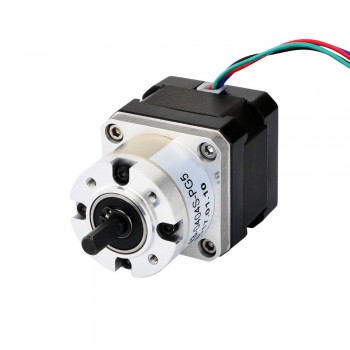
A geared stepper motor is a modular assembly that fuses a stepper motor with a matching gearbox. The stepper motor serves as the power source, converting electrical energy into mechanical energy to generate rotational motion; the gearbox, as a speed-torque conversion mechanism, reduces the output speed of the stepper motor while proportionally increasing the output torque, and at the same time reduces the backlash (return clearance) to improve the positioning accuracy and motion stability of the entire system.

2.Main Working Principles of Geared Stepper Motor
1.Pulse-Based Operation: The stepper motor receives digital pulses, where each pulse corresponds to a specific, small step angle, allowing for precise control of speed and position.
2.Gearbox Reduction: The motor shaft drives a gear train (often planetary gears). This reduces the speed and increases the torque, allowing a small motor to move heavier loads.
3.High-Precision Control: The gearbox multiplies the resolution, meaning the output shaft moves much less than the internal motor shaft per pulse, leading to superior accuracy.
4.Direction and Speed Control: The frequency of the pulses determines the output speed, while the sequence of pulses controls the direction (clockwise or counter-clockwise).

3.Performance Advantages of Geared Stepper Motor
1.High Positioning Accuracy:The stepper motor itself has precise step angle control, and the gearbox further reduces the backlash, which effectively avoids the positioning error caused by the motor’s own rotation clearance. This enables the geared stepper motor to achieve high-precision positioning in applications such as 3D printer extruders and robotic arm joints, ensuring the stability and consistency of the equipment’s work.
2.Large Torque Output:A major limitation of standalone stepper motors is that their output torque is small, especially at high speeds, which makes them unable to drive heavy loads. The gearbox in the geared stepper motor can amplify the torque proportionally according to the reduction ratio, which solves the problem of insufficient torque of the stepper motor.
3.Stable Low-Speed Operation:Standalone stepper motors are prone to “low-speed vibration” when operating at low speeds, which affects the stability of the equipment. The gearbox can reduce the output speed of the motor, and the damping effect of the gear transmission can effectively suppress low-speed vibration, making the geared stepper motor run smoothly at low speeds.
4.Compact Structure and High Integration:The geared stepper motor integrates the stepper motor and gearbox into one module, which is more compact in structure compared to the separate installation of the motor and gearbox, saving installation space. At the same time, the integrated design ensures the coaxiality of the motor and gearbox, avoiding the performance degradation caused by improper installation, and reducing the difficulty of equipment design and assembly.
5.Good Reliability and Long Service Life:The stepper motor has no brush and commutator, so there is no wear caused by brush friction, and the service life is long; the gears in the gearbox are made of high-strength materials and processed by precision technology, which has good wear resistance and load-bearing capacity.

4.Design Principles of Geared Stepper Motor
1.Principle of Performance Matching:Performance matching is the core principle of geared stepper motor design, which mainly includes the matching of the stepper motor and gearbox in terms of speed, torque, and step angle. First, according to the actual application requirements, determine the required reduction ratio and output torque, then select a stepper motor with appropriate rated torque and speed, and match a gearbox with corresponding reduction ratio and torque-bearing capacity.
2.Principle of Minimum Backlash:Backlash is the main factor affecting the positioning accuracy of the geared stepper motor, which refers to the angular clearance between the gears when the direction of rotation changes. The design should minimize the backlash on the premise of ensuring the smooth operation of the gearbox.
3.Principle of Compact and Lightweight Structure:Geared stepper motors are often used in small and medium-sized automation equipment, so the design should follow the principle of compact structure and lightweight to save installation space and reduce the overall weight of the equipment
4.Principle of High Efficiency and Low Loss:The efficiency of the geared stepper motor directly affects its energy consumption and heat generation, so the design should focus on improving efficiency and reducing energy loss. First, select a gearbox with high transmission efficiency; second, optimize the gear tooth profile design to reduce friction between gear teeth.
5.Principle of Reliability and Durability:The geared stepper motor needs to maintain stable operation for a long time in various working environments, so the design must follow the principle of reliability and durability. In terms of material selection, the gears should be made of high-strength, wear-resistant materials to withstand long-term load impact; the housing should be made of corrosion-resistant materials to adapt to harsh working environments.
6.Principle of Standardization and Universality:To facilitate production, installation, and maintenance, the design of the geared stepper motor should follow the principle of standardization and universality. The stepper motor should adopt standard models with unified mounting dimensions and lead wire specifications; the gearbox should also adopt standard reduction ratios and output shaft specifications, so that users can easily replace and maintain components.

Core selection principles of helical planetary gearbox

1.Definition of helical planetary gearbox
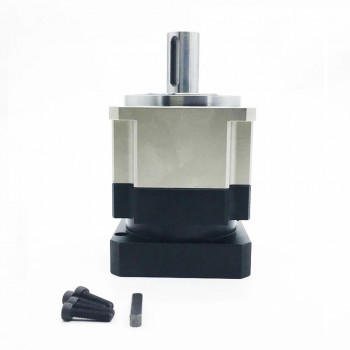
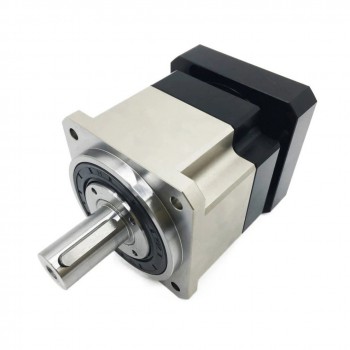
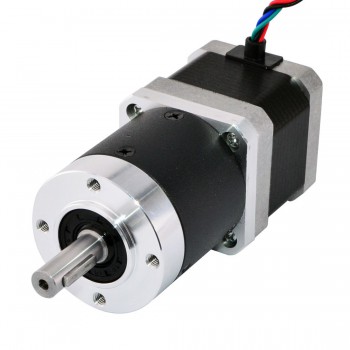
A helical planetary gearbox is a type of closed transmission mechanism that integrates helical gear meshing and planetary gear train structure.The core feature that distinguishes it from spur planetary gearboxes is that the teeth of the sun gear, planet gears, and ring gear are processed into a helical shape, forming an inclined meshing relationship during transmission. This design not only inherits the compactness and high torque density of planetary gearboxes but also optimizes meshing performance, reducing noise and improving transmission smoothness.

2.Key working principles of helical planetary gearbox
1.Helical Tooth Engagement: The angled teeth of the gears do not engage instantly; they mesh gradually. This continuous, progressive engagement reduces vibration, minimizes noise, and supports higher load capacities.
2.Planetary Motion: The sun gear acts as the input, driving multiple planetary gears that rotate on their own axes. These planets also revolve around the sun gear while engaged with an outer ring gear, creating a “solar system” motion.
3.Torque Distribution: By dividing the load across multiple planetary gears, the gearbox achieves high torque density and efficiency (often 95-98%) within a compact, coaxial design.
4.Reduction Ratios: The gear ratio is determined by the number of teeth on the sun and ring gears. The output is typically taken from the planet carrier, providing significant speed reduction.
5.Load Balancing: The helical design ensures that multiple teeth are in contact at any given time, providing smoother motion transfer and reducing wear on components.

3.Structure advantages of helical planetary gearbox
1.High Transmission Smoothness and Low Noise: The helical teeth have a longer meshing line and gradual meshing process, which eliminates the impact and vibration caused by the instantaneous engagement of spur gears. In actual operation, the noise level is usually 10-15 dB lower than that of spur planetary gearboxes, which is particularly suitable for equipment requiring low noise.
2.High Torque Density and Compact Structure: The planetary gear train structure enables multiple planet gears to share the load simultaneously, which greatly improves the torque-bearing capacity under the same volume. The helical tooth design further increases the contact area of the teeth, avoiding local overloading and tooth breakage.
3.High Transmission Accuracy and Repeatability: The helical tooth meshing has a smaller backlash than spur gears, and the planetary structure ensures uniform force distribution, reducing transmission errors. For precision-modified helical planetary gearboxes, the backlash can be controlled below 1 arcmin, which can meet the high-precision positioning requirements of CNC machine tools, robotic arms, and other equipment.
4.High Transmission Efficiency: The line contact of helical teeth reduces friction loss during meshing, and the planetary gear train has a short transmission path. Under normal operating conditions, the transmission efficiency of a helical planetary gearbox can reach 95%-98%, which is much higher than that of worm gearboxes and helps to save energy and improve the efficiency of the entire system.
5.Strong Durability and Long Service Life: The helical tooth design reduces tooth surface wear and fatigue damage, and the compact structure is conducive to heat dissipation. With reasonable lubrication and maintenance, the service life of helical planetary gearboxes is usually 2-3 times that of spur planetary gearboxes in heavy-load applications.

4.Core selection principles of helical planetary gearbox
1.Match the Transmission Ratio and Speed Range: The transmission ratio is the primary parameter for selection, which is determined by the speed of the prime mover and the required speed of the load. When selecting, it is necessary to ensure that the rated output speed of the gearbox is within the allowable speed range of the load, and there should be a certain margin to avoid over-speed operation.
2.Verify Torque Capacity and Load Characteristics: The rated output torque of the gearbox must be greater than the actual required torque of the load, including the rated load torque, peak load torque, and inertial torque .The safety factor should be 1.2-2.0.
3.Ensure Transmission Accuracy and Backlash Requirements: For equipment requiring high-precision positioning, the backlash and transmission error of the gearbox are key indicators. The backlash should be selected according to the positioning accuracy requirements.
4.Consider Installation Space and Coaxiality: Helical planetary gearboxes are usually used for coaxial transmission, so the installation space of the gearbox must match the overall layout of the equipment. For compact equipment, it is necessary to select a gearbox with a small volume and light weight.
5.Evaluate Noise and Vibration Requirements: For noise-sensitive applications , the noise level of the gearbox must be controlled within the allowable range.
6.Check Lubrication and Maintenance Conditions: The lubrication of helical planetary gearboxes directly affects their service life and operating stability. For long-term continuous operation scenarios, it is necessary to select gearboxes with lifelong lubrication to avoid frequent lubrication replacement.
7.Match the Prime Mover and Load Interface: The input interface of the gearbox must match the output interface of the prime mover (motor), and the output interface must match the input interface of the load.
8.Balance Economic Benefits and Reliability: Under the premise of meeting the technical requirements, the cost of the gearbox should be considered. Customized gearboxes are more expensive than standard products, so standard products should be preferred as much as possible.