1.Knowing about the right angle planetary gearbox
A right angle planetary gearbox is a gear drive or speed reducer where the input and output shafts are positioned at a 90-degree angle to each other. It utilizes an epicyclic (planetary) gear arrangement—consisting of a sun gear, planet gears, a planet carrier, and a ring gear—to distribute the load across multiple gear meshes, resulting in high torque density, increased efficiency, and a compact design. The key distinction from a standard in-line planetary gearbox is the inclusion of a bevel or hypoid gear set, which facilitates the change in the axis of rotation.
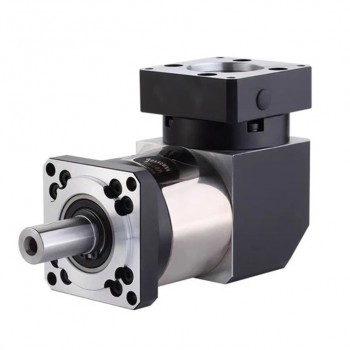
2.Key components of right angle planetary gearbox
1.Sun Gear: The central driving gear, usually connected to the input motor shaft, that initiates the movement of the system.
2.Planet Gears: Multiple gears (typically three or more) that mesh with the sun gear and orbit around it. Distributing the load among these gears is the reason for the system’s high torque capacity.
3.Ring Gear (Annulus): The outer stationary ring with internal teeth that enclose the entire assembly and mesh with the planet gears.
4.Planet Carrier: A structural component that holds the planet gears in alignment and typically serves as the output shaft, delivering the reduced speed and increased torque.
5.Right-Angle Gearing: An integrated stage of gears (commonly spiral bevel gears for quiet, smooth operation, or hypoid gears for high torque and an axis offset) that intercepts the power flow and changes its direction by 90 degrees.
3.Performance features of right angle planetary gearbox
1.High Torque Density and Capacity: The planetary design distributes the load across multiple planet gears simultaneously, allowing the gearbox to transmit a high amount of torque relative to its compact size. This makes it suitable for heavy-duty applications and high shock loads.
2.High Efficiency: Due to the efficient rolling contact of the gears, these gearboxes typically boast very high mechanical efficiency, often exceeding 95% per stage, which minimizes energy loss, heat generation, and operating costs.
3.Wide Gear Ratio Range: The modular nature of the planetary stages allows for a broad spectrum of reduction ratios, which can be tailored to meet diverse speed and torque requirements (from 3:1 to over 300:1).
4.Low Backlash: Many right angle planetary gearboxes are precision-engineered to offer very low backlash (as low as 2 arc-minutes), which is critical for applications requiring accurate positioning and precise motion control, such as in robotics and CNC machinery.
5.High Torsional Stiffness: The rigid construction, often featuring one-piece planet carriers and robust bearings, provides high torsional stiffness, ensuring minimal play and superior positional accuracy.
6.Smooth and Quiet Operation: The combination of precision-cut gears (often helical or spiral bevel) and balanced load distribution results in smoother operation, reduced vibration, and lower noise levels compared to some other gear types.
7.Compact, Space-Saving Design: The right-angle configuration allows the input motor to be placed parallel to the machine body, drastically reducing the overall footprint and making it ideal for confined installation spaces.
8.Durability and Reliability: Constructed with high-grade materials, such as hardened and ground steel gearing and high-capacity bearings, these gearboxes are built for a long service life, even under demanding operational conditions.
9.Versatile Mounting Options: They typically feature standardized input flanges (e.g., ISO 9409) and various output configurations (shaft, hollow shaft, flange), offering design flexibility and easy integration with different servo or stepper motors and machinery layouts.
10.Maintenance-Free Operation: Many models are lifetime-lubricated with synthetic grease and have high ingress protection ratings (e.g., IP65), reducing maintenance requirements.
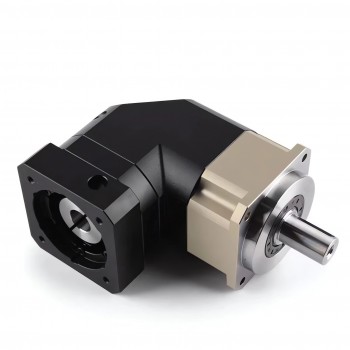
4.Design problems of right angle planetary gearbox
1.Reduced Efficiency (Compared to In-line Planetary): While planetary gears are efficient, the addition of the right-angle stage (e.g., spiral bevel gears) introduces an extra mesh point and often more sliding contact than pure rolling, slightly reducing overall efficiency and generating more heat.
2.Heat Buildup in Compact Housing: The primary advantage of a compact design also creates a disadvantage in heat management. The smaller surface area can make it difficult for heat to dissipate effectively, potentially leading to lubricant breakdown or overheating if not adequately addressed through cooling fins, proper lubrication choice, or external cooling.
2.Uneven Load Sharing: In an ideal planetary system, the load is shared equally among all planet gears. However, inevitable manufacturing tolerances and installation errors can lead to uneven load distribution, resulting in some gears carrying more load than intended, which reduces durability and lifespan.
3.Radial and Axial Loads: The right-angle configuration, particularly with bevel gears, generates significant inherent axial (thrust) forces in addition to radial loads. The bearing systems must be robustly designed to handle these combined forces effectively without excessive deflection.
4.Managing Backlash in Multiple Stages: Controlling backlash (the small amount of play between meshing teeth) is a key challenge. Achieving extremely low backlash requires tighter tolerances and more expensive manufacturing processes.
5.Noise and Vibration: Like any gearbox, gear meshing generates noise and vibration. The added complexity and multiple contact points can sometimes lead to higher running noise compared to simpler coaxial planetary gearboxes, a factor that needs addressing in sensitive applications.
6.Orientation Sensitivity: The orientation of a right angle gearbox (horizontal vs. vertical mounting) can affect how the lubricant flows to all necessary components. Proper design must account for different mounting configurations to ensure consistent lubrication of all gear meshes and bearings.
7.Inaccessibility for Maintenance: The compact and integrated nature of the design often makes internal components inaccessible for inspection or repair, meaning that issues can be difficult to diagnose without full disassembly.