1.Basic knowing about helical planetary gearbox
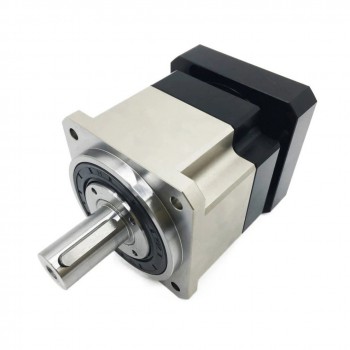
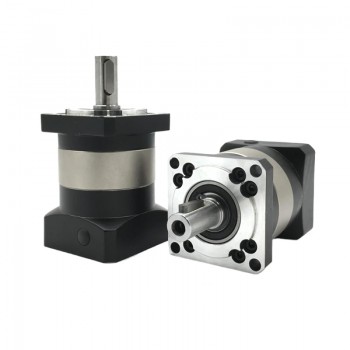
A helical planetary gearbox combines the compact, high-torque design of a planetary system with the smooth, quiet operation of angled helical teeth, ideal for robotics, automotive, and precision machinery needing high load capacity and low noise, though it creates axial thrust requiring extra bearings and can be more costly than spur gear versions. The angled teeth engage gradually, sharing the load over a larger area, leading to better performance but also generating axial forces.
2.Working principle of helical planetary gearbox
1.Input: Power enters via the input shaft, rotating the central sun gear.
2.Meshing: The sun gear’s rotation forces the planet gears to spin on their own axes and simultaneously orbit the sun gear, as they mesh with both the sun and the internal teeth of the ring gear.
3.Load Sharing: Because multiple planet gears engage at once, the load is distributed, allowing for high torque capacity in a compact space.
4.Helical Advantage: The angled teeth of the helical gears engage more gradually and smoothly than straight (spur) gears, reducing noise, vibration, and stress, while improving power transmission.
5.Output: The planet carrier, which holds the planets, rotates with them. When the carrier is fixed, the ring gear often becomes the output; when the ring gear is fixed, the carrier is the output (or vice versa), providing speed reduction and torque multiplication.
3.Technology advantages of helical planetary gearbox
1.Smooth and Quiet Operation:Helical gearboxes operate smoothly and quietly due to their angled teeth design. This design enables gradual gear engagement, resulting in continuous power transfer. Compared to spur gears, helical gearboxes produce less vibration and noise, making them suitable for low-noise applications.
2.High Load Capacity:Helical gearboxes offer superior load-bearing capacity compared to straight-cut gears. The angled tooth design distributes force across a larger contact area, enabling higher load handling without risking damage or premature wear. This increased capacity allows for the use of smaller gears in power transmission applications, resulting in more compact and lightweight gearbox designs.
3.Evenly Distributed Load:Helical gearboxes distribute loads evenly across gear teeth due to their angled tooth design. This design allows multiple teeth to engage simultaneously, sharing the load and reducing stress on individual teeth. The gradual engagement of helical gear teeth contrasts with the all-at-once engagement of spur gears.
4.Compact Design:Helical gearboxes provide design flexibility. Their small size enables creative and streamlined machine designs, potentially enhancing product aesthetics and functionality. The reduced size can also improve heat dissipation due to less mass retaining heat, potentially increasing gearbox efficiency and longevity.
5.Versatile Configurations:Helical gearboxes offer diverse configurations to meet specific application needs. Shaft orientations include parallel, right-angle, and multi-stage designs, adapting to space constraints and operational requirements.
6.mproved Durability:The gradual tooth engagement in helical gears decreases shock and impact during operation, improving durability. This results in reduced tooth breakage and increased resistance to fatigue, particularly in high-speed or high-load applications. Helical gears’ ability to handle greater torque capacity also contributes to their longevity.
7.Ability to Connect Non-parallel Shafts:Helical gearboxes connect non-parallel shafts, a feature that distinguishes them from other gear systems. This capability enables power transmission between offset or intersecting shafts at various angles, including right angles. Engineers can design more compact and space-efficient machinery layouts using helical gears.
4.Efficiency improving methods of helical planetary gearbox
1.Tooth Surface Modification: Combining helix modification with drum shaping reduces transmission errors by roughly 19.9% and vibration by 21%. This minimizes “edge contact” under load, lowering local friction.
2.Reduced Sliding Contacts: Using “double staggered helical gears” with shortened teeth can improve transmission efficiency by about 1.8 percentile points by avoiding contact in high-sliding zones.
3.Helix Angle Tuning: While larger angles improve smoothness, they generate axial thrust that increases bearing friction. Maintaining the helix angle between 10° and 25° is often optimal for balancing smoothness with power loss.
4.Surface Finish Optimization: High-precision grinding (Grade 6 accuracy) and abrasive flow finishing can increase efficiency by up to 3.3% by minimizing surface roughness and friction.
5.Specialized Coatings: Low-friction coatings (e.g., diamond-like carbon) and case-hardened carburized steel are used to reduce wear and maintain smooth surfaces over the gearbox’s lifespan.
6.Lightweighting: Replacing standard steel housings with high-strength alloys or carbon fiber-reinforced composites can reduce overall weight by 20–30%, lowering inertia-related losses.
7.Bio-based & Synthetic Lubricants: Advanced synthetic and bio-based oils (expected to reach 15% application by late 2025) provide superior temperature stability and lower viscosity-related churning losses.
8.Smart Lubrication Systems: Implementing closed-loop, digitally integrated lubrication can extend drain intervals by 35% and reduce energy intensity by up to 12%.
9.Optimized Immersion: Utilizing SPH modeling to find the ideal oil immersion depth (e.g., ~3.0h) can increase lubricant volume in the meshing zone by 183%, significantly reducing heat and friction.
10.Variable Speed Drives (VSD): Integrating VSDs helps manage input speeds to keep the gearbox within its most efficient load range.