1.What is a geared stepper motor?
A geared stepper motor combines a standard stepper motor with a gearbox (gear reduction unit), integrating precise step-based motion with mechanical advantages to provide high torque and low speed from a single unit, ideal for applications needing powerful, accurate positioning without feedback, like robotics or 3D printers. The gearbox reduces rotational speed while multiplying output torque, with planetary or spur designs being common.
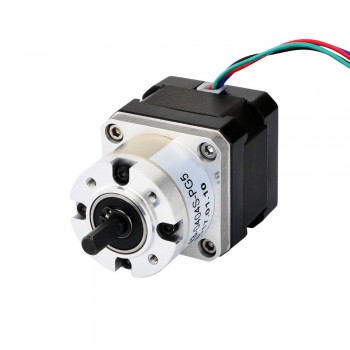
2.Basic working principle of geared stepper motor
The core principle behind a gear motor is simple mechanics: gears. The electric motor spins at a high speed but has low torque. The gearbox, which contains a series of gears of different sizes, takes this high-speed rotation and transforms it. As the smaller gears turn the larger gears, the rotational speed decreases, and the torque increases. Think of it like a bicycle. When you are in a low gear, you pedal faster (high speed) but with less effort, allowing the bike to move at a certain pace. When you shift to a higher gear, you pedal more slowly (lower speed), but with more effort, allowing you to go up a hill or accelerate. In a gear motor, the gearbox acts like a bicycle’s gears, but it’s designed for a specific and continuous purpose.
3.Technical features of geared stepper motor
1.Precision Gear Mechanisms: High-performance units utilize planetary gearheads for high torque density and harmonic (strain wave) gears for zero-backlash operation. Modern scissors gear systems are also used in planetary designs to eliminate backlash, which is critical for sub-arc-minute positioning accuracy.
2.Torque Multiplication and resolution: By using high gear ratios (e.g., 5:1 to 50:1), these motors significantly increase output torque while reducing the effective step angle. For example, a 1.8° motor with a 10:1 gear ratio achieves a resolution of 0.18° per step.
3.High Torsional Rigidity: Geared designs are engineered for high rigidity, making them less prone to twisting under fluctuating loads. This is essential for maintaining stability in vertical drives like elevators or security cameras subjected to external forces like wind.
4.Miniaturization: New metallurgical processes and additive manufacturing allow for ultra-compact designs that maintain high torque density, supporting the 2025 trend toward portable and handheld medical and robotic devices.
5.IoT and Remote Monitoring: 2025 models increasingly feature IoT and Wi-Fi connectivity, allowing for remote monitoring of health parameters such as temperature, noise, and vibration for predictive maintenance.
6.Closed-Loop Functionality: Many modern geared steppers incorporate integrated absolute encoders. This enables “step-servo” performance, where the system can detect and correct missed steps in real-time, eliminating the risk of stalls common in open-loop systems.
7.Industrial Network Support: Controllers now support high-speed communication protocols such as EtherCAT, EtherNet/IP, and Modbus (RTU), facilitating seamless integration into Industry 4.0 smart factory environments.
8.Optimized Microstepping: Advanced drivers use algorithms to further subdivide steps (up to 256 microsteps per full step), providing extremely smooth motion and reducing the mechanical resonance that typically causes noise and vibration.
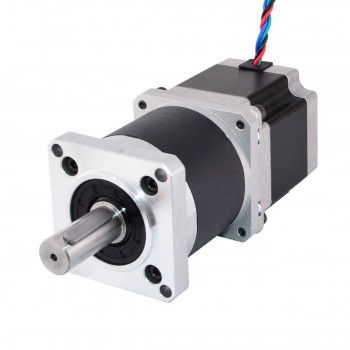
4.Key specifications and considerations of geared stepper motor
1.Torque and Speed Requirements:The most important factors to consider are the torque and speed required by your application. Torque is the rotational force needed to do the work (e.g., lift a weight), while speed is the rotational velocity. A mismatch in either of these can lead to system failure. You must determine the maximum and continuous torque and speed needed to handle both peak loads and sustained operation.
2.Gear Ratio Selection:The gear ratio is the factor that defines the relationship between the motor’s input speed and the gearbox’s output speed. A higher gear ratio provides a greater reduction in speed and a proportional increase in torque. Selecting the correct ratio ensures that the motor operates efficiently, without overheating or failing under stress, and delivers the precise output required for the application.
3.Motor Voltage and Power:You must choose a gear motor with the correct voltage and power rating for your power supply. Common voltages include 12V, 24V, and 48V for DC motors, and various single-phase or three-phase options for AC motors. The power rating, measured in watts, indicates the motor’s ability to perform work. Selecting a motor that is underpowered can lead to burnout, while one that is overpowered can be a waste of energy and money.
4.Efficiency and Thermal Performance:Efficiency is a measure of how well the gear motor converts electrical energy into mechanical output, with a portion of the energy lost as heat. A more efficient gear motor generates less heat, which improves its lifespan and saves energy. Thermal performance is a critical consideration for continuous operation. If a motor gets too hot, it can damage internal components. It’s crucial to select a motor with adequate heat dissipation or to use an external cooling system if the application generates high temperatures.
5.Size and Mounting Options:The physical dimensions of the gear motor and its mounting configuration are practical considerations. You must ensure the motor fits within the available space and can be securely mounted. Common mounting styles include flange mounts, face mounts, and foot mounts. The orientation of the output shaft (e.g., in-line, right-angle) is also a key factor in fitting the motor into the machinery’s design.